Key points
- Monitoring helps detect problems earlier
- Response and restoration targets differ
- Backup and security scope must be explicit
- Alternate links and tested recovery support resilience
- A managed service cannot eliminate every outage
In this article
Network faults can interrupt business applications, branch connectivity and staff productivity. Managed Network Services combine agreed monitoring, maintenance and support activities to help identify problems earlier and reduce the impact of outages. They cannot prevent every disruption.
This guide explains the service scope, technologies, operational limits and evaluation questions that matter when choosing managed network support.
What Are Managed Network Services?
Managed Network Services (MNS) involve outsourcing the daily management of your network infrastructure to a specialized provider. This includes:
- Network monitoring and maintenance
- Performance optimization
- Security management
- Troubleshooting and support
- Network configuration backup and restoration, when included in the contract
A provider can monitor the covered environment, investigate alerts and coordinate corrective actions. Monitoring hours, supported devices, access permissions and escalation responsibilities must be defined in the service agreement.
Managed network services may cover:
- LAN/WAN services
- SD-WAN and cloud networking
- Network security and firewalls
- Managed Wi-Fi
- Remote monitoring and support
How Managed Services Help Reduce Downtime
1. Proactive Monitoring
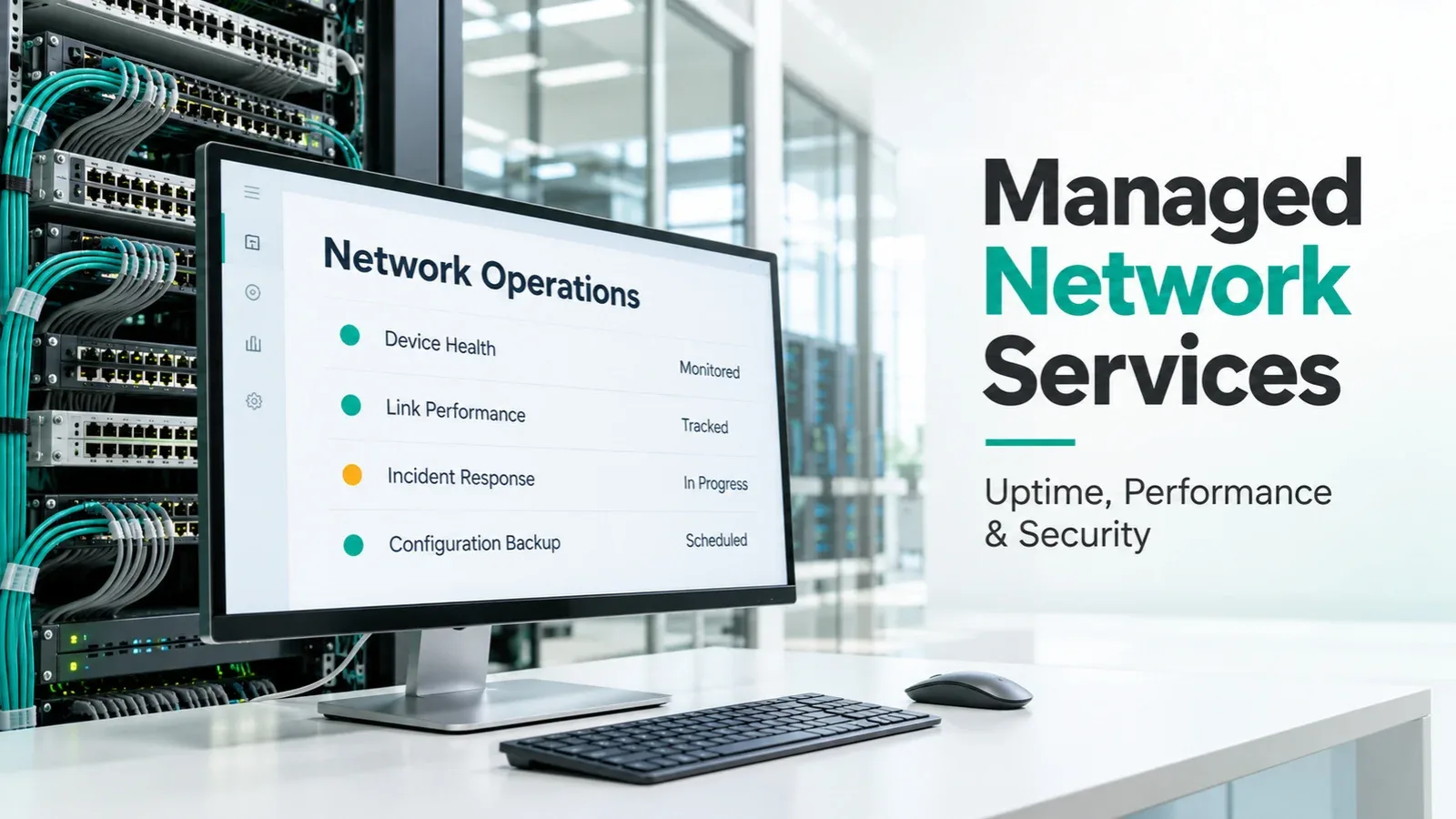
Monitoring can track link availability, latency, packet loss, device health and other supported metrics. Alerts help identify problems, but their value depends on coverage, thresholds and a team authorized to act.
2. Rapid Response and Troubleshooting
Defined incident procedures can shorten investigation and escalation. Response time differs from restoration time, and neither should be assumed without checking the contract and the dependencies involved.
3. Smart Security and Threat Protection
The service may include firewall administration, security-event monitoring and planned software updates. Confirm the controls and update responsibilities included, because network monitoring alone is not a complete security operation.
4. Backup & Recovery Support
Configuration backups and recovery procedures can help restore network devices after a fault or change. Application and data backup, disaster recovery design and recovery testing are separate responsibilities unless explicitly included.
5. Planned Upgrades and Migrations
A provider can plan network changes, maintenance windows, testing and rollback. Some upgrades require an interruption, so a zero-interruption migration should not be promised without a tested design.
Technologies Behind Managed Network Services
Several underlying technologies make managed network services efficient and reliable:
SD-WAN & Intelligent Routing
SD-WAN can steer traffic across available WAN paths using policy and measured link conditions. Resilience depends on functioning alternate links, device availability and the behavior of applications during failover.
Real-Time Analytics & AIOps
Analytics and AIOps can help correlate alarms, identify unusual behavior and recommend action. They do not reliably predict every outage, and automated changes need testing and control.
Cloud-Managed Infrastructure
Cloud-hosted management tools can centralize visibility and configuration across sites. Device support, management connectivity and the effect of individual changes still need to be assessed.
The Future of Managed Network Services
Development areas include greater automation, broader coverage and improved service measurement. Their availability depends on the platform and provider.
Automation and Controlled Remediation
Automation can handle defined monitoring and remediation tasks. More autonomous operation is a development direction, with safeguards needed to prevent an incorrect action from widening an outage.
Edge & IoT-Aware Network Management
Increasing numbers of edge devices and IoT systems require specialized monitoring and segmentation, managed services are expanding to include these areas for enhanced performance and security.
Cloud Native and Distributed Architecture
Hybrid and multicloud environments require visibility into cloud services, site links and responsibilities shared with providers. A single management platform does not guarantee consistent performance across every environment.
Service Measurement and SLA Review
A useful SLA specifies the monitored scope, service hours, incident priorities, response targets, exclusions and reporting method. Compare those commitments with actual incident and availability records.
Managed Network Services can improve operational visibility and support more consistent maintenance and incident handling. The outcome depends on network design, service scope, staff capability and cooperation between the provider, customer and connectivity suppliers.
Choose a service against the business systems and locations it must support. Reliable operations require a clear contract, tested recovery arrangements and measurable follow-through.
Service Limits and Questions to Agree Before Signing
Define which devices, sites, links and cloud services are covered. Confirm monitoring and support hours, planned-maintenance exclusions, escalation contacts and the customer’s retained responsibilities.
A provider cannot repair an ISP’s physical circuit, replace unsupported hardware or recover application data without the access, parts, contractual scope and recovery arrangements needed. Assess recurring faults, incident timelines and tested failover alongside availability reports.
Practical Next Step
Document the sites, critical applications, current faults and support gaps before comparing offers. Discuss managed network requirements with Servicing24 Limited.
Sources and Further Reading
Common questions
What do Managed Network Services include?
They cover the monitoring, maintenance and support activities defined in the contract. LAN, WAN, Wi-Fi, firewall and cloud-network tasks may be included, but the scope must be checked.
Can a managed network provider eliminate downtime?
No provider can prevent every fault. Monitoring, maintenance, redundancy and incident procedures can reduce the frequency or impact of outages.
Is a response-time SLA the same as a restoration guarantee?
No. Response concerns when an incident is acknowledged or action begins. Restoration depends on the fault, dependencies and the specific contractual commitment.
Are application backups automatically included?
No. Network configuration backups, data backup and disaster recovery are separate activities unless explicitly included in the service agreement.
What should be checked before selecting a provider?
Check covered devices and sites, service hours, alert ownership, escalation, remote and on-site support, change control, recovery responsibilities and reporting.
Need help with this in your own setup?
Talk to a Servicing24 engineer. We’ll give you a plan and a clear price.