Key points
- SD-WAN operates over underlying transport services
- Policy selects among available network paths
- Link failover does not guarantee zero downtime
- Remote-user security requires the appropriate access services
- Compare total cost and test a representative branch
In this article
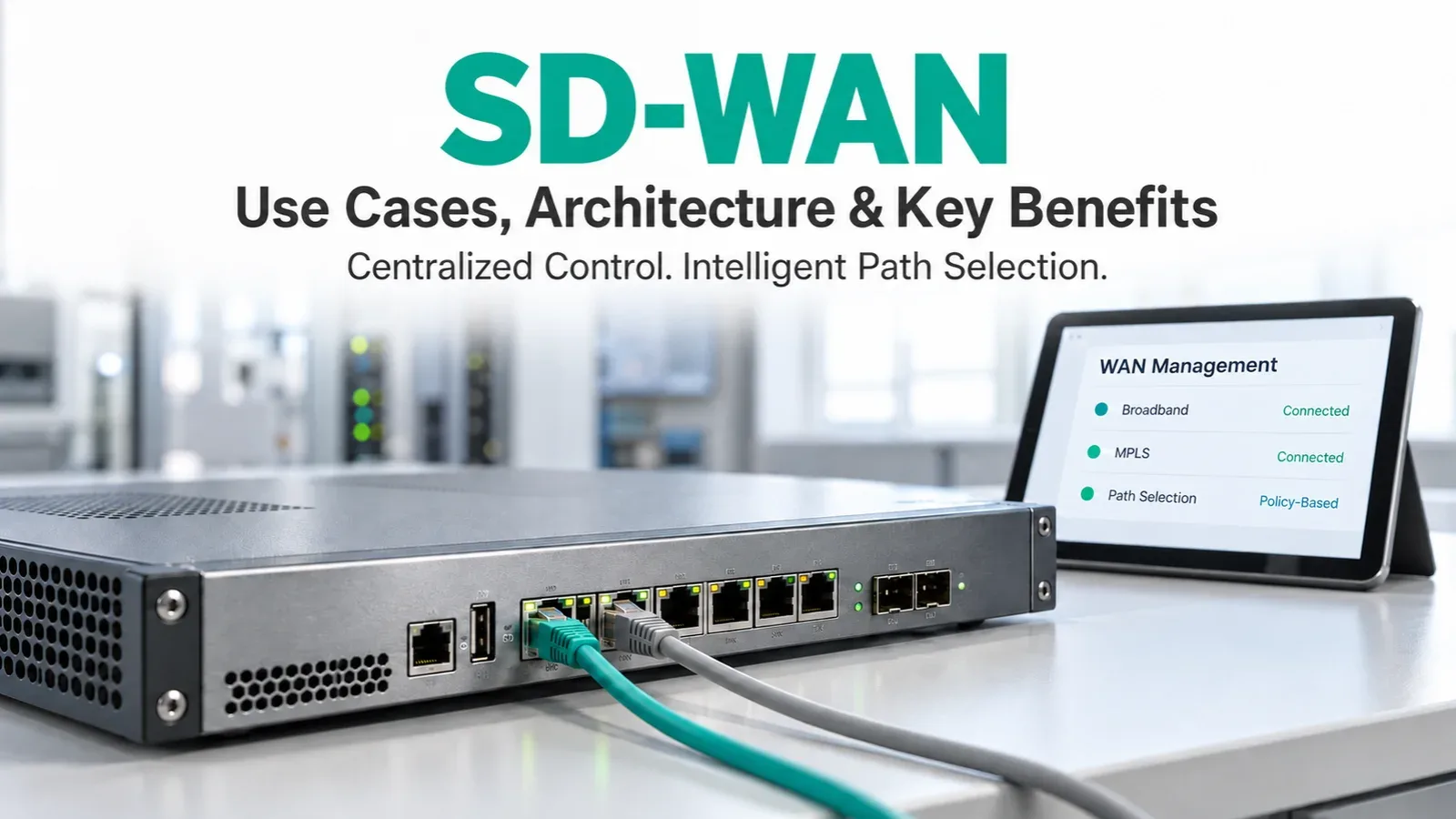
SD-WAN, or Software-Defined Wide Area Networking, applies software-defined policy and centralized management to WAN connectivity. It can help connect branches, data centers and cloud applications across available transports, with traffic steering based on application needs and link conditions.
SD-WAN can operate over MPLS, broadband and cellular links such as LTE or 5G, depending on the platform. It is an overlay and management approach, while those services provide the underlying transport. MPLS and SD-WAN can therefore be used together.
SD-WAN Architecture in Practice
WAN edges connect sites and forward application traffic over the configured overlay tunnels and transport links. Central management handles onboarding, configuration, policy and visibility. Control-plane services distribute the reachability and policy information needed by the deployment. Product designs differ, so these functions may be hosted or combined in different ways.
The data plane carries traffic, while control and management functions coordinate behavior. Resilience must account for these components, device power and the transport network. A second circuit through the same last-mile infrastructure may leave a shared failure point.
Key Use Cases for SD-WAN
1. Hybrid WAN for Distributed Enterprises
Organizations with multiple branches can use SD-WAN to unify network connectivity across locations, regardless of whether traffic goes to data centers, cloud apps, or internet destinations.
2. Cloud and SaaS Optimization
A design can send suitable application traffic directly toward cloud services instead of routing everything through a central site. This may improve the traffic path, but latency still depends on connectivity, service location and policy.
3. Integration with Secure Remote Access
SD-WAN can connect with SSE or SASE services that provide user-access and security functions. A branch SD-WAN appliance alone is not a complete remote-user ZTNA or VPN service.
4. Cost-Effective Transport
Combining transport types can change the WAN cost structure. Compare connectivity, equipment, subscriptions, security, migration and support costs. Savings and reliability should be demonstrated for the proposed design.
5. Link Resilience and Failover
SD-WAN can move traffic to an available path during a link fault or degraded conditions. Detection time, application behavior, firewall state and common dependencies can still cause interruption.
Key Benefits of SD-WAN
1. Improved Performance
Application-aware routing and prioritization can improve the use of available links. Performance remains constrained by capacity, loss, delay and the application’s requirements.
2. Cost Savings
Broadband and cellular services can complement or replace selected MPLS connections when they meet requirements. Use a workload and site-level cost comparison rather than assuming that every migration saves money.
3. Better Cloud Connectivity
Direct connectivity or cloud on-ramp integrations can offer alternative paths to applications. Check routing, security inspection and measured user experience for each important service.
4. Centralized Control & Agility
Central management can distribute templates and policies across supported edge devices. Initial onboarding, site dependencies, exceptions and validation still require planning.
5. Enhanced Resiliency
Redundant links and policy-based path selection can improve continuity. Edge devices, power, last-mile routes and upstream providers can remain single points of failure.
6. Integrated Security
Security features or SSE integrations can add firewalling, web controls and application access. Their availability and performance depend on the selected products and licenses.
Limitations & Considerations
While SD-WAN offers many advantages, it’s important to be aware of its limitations:
1. Increased Complexity
The abstraction layer and policy engine add complexity that requires skilled management and planning.
2. Integration Challenges
Integrating SD-WAN with existing MPLS, security stacks, and on-prem infrastructure can be complex without expert guidance.
3. Security Responsibility
While SD-WAN can integrate security features, it does not replace dedicated security firewalls or Zero Trust access controls unless those tools are integrated.
4. Vendor Fragmentation
Different vendors offer varying feature sets, and interoperability between vendors can be limited, careful vendor evaluation is essential.
Development Directions for SD-WAN
1. Full Convergence with SASE
SASE combines WAN networking with cloud-delivered security functions. Such integration is already available in some offerings, while the scope and operational integration vary by provider.
2. AI-Driven Traffic Optimization
Analytics can help identify degraded paths and suggest policy improvements. Automated changes require validation and safeguards against disrupting important applications.
3. Multi-Cloud Native Integration
Cloud integrations can extend connectivity and management to supported environments. Universal feature parity across every cloud should not be assumed.
4. Edge and 5G-Enabled WAN
Cellular links and edge deployments can extend WAN reach. Coverage, signal quality, capacity and carrier routing determine whether latency-sensitive applications are suitable.
5. Zero Trust and Identity-Aware Routing
Identity and device context can inform policy where the platform supports it. This should be distinguished from a guarantee that all SD-WAN products provide complete Zero Trust access.
SD-WAN can provide a useful foundation for managing distributed connectivity when the network, security and operational design are aligned. It should be evaluated against the existing WAN and the applications that depend on it.
Begin with a representative branch pilot. Test application performance, failover, recovery and management access under realistic conditions before a wider rollout.
Practical Next Step
Prepare the site list, circuits, application priorities and security requirements for a pilot. Discuss WAN requirements with Servicing24 Limited.
Sources and Further Reading
Common questions
Does SD-WAN replace MPLS?
It can use MPLS alongside broadband and cellular services. SD-WAN is an overlay and control approach, while MPLS is an underlying transport option.
Does SD-WAN guarantee zero downtime?
No. Failover depends on working alternate paths, detection time, edge availability and application behavior. Shared dependencies can still interrupt service.
Is SD-WAN a complete remote-access security solution?
Not by itself. Remote users may need ZTNA, VPN or other access services integrated with the network and identity design.
Will every SD-WAN deployment reduce costs?
No. Compare circuits, devices, subscriptions, security, implementation, migration and ongoing support against the current WAN.
How should an SD-WAN project be validated?
Pilot representative sites and applications. Measure latency, loss, throughput, failover behavior, recovery, security enforcement and management access.
Need help with this in your own setup?
Talk to a Servicing24 engineer. We’ll give you a plan and a clear price.