Key points
- Use the benchmark matching the product and software version
- Secure management access and maintain supported software
- Validate dependencies before rule removal
- Define useful logging and protect its retention
- Automated checks do not prove complete compliance
In this article
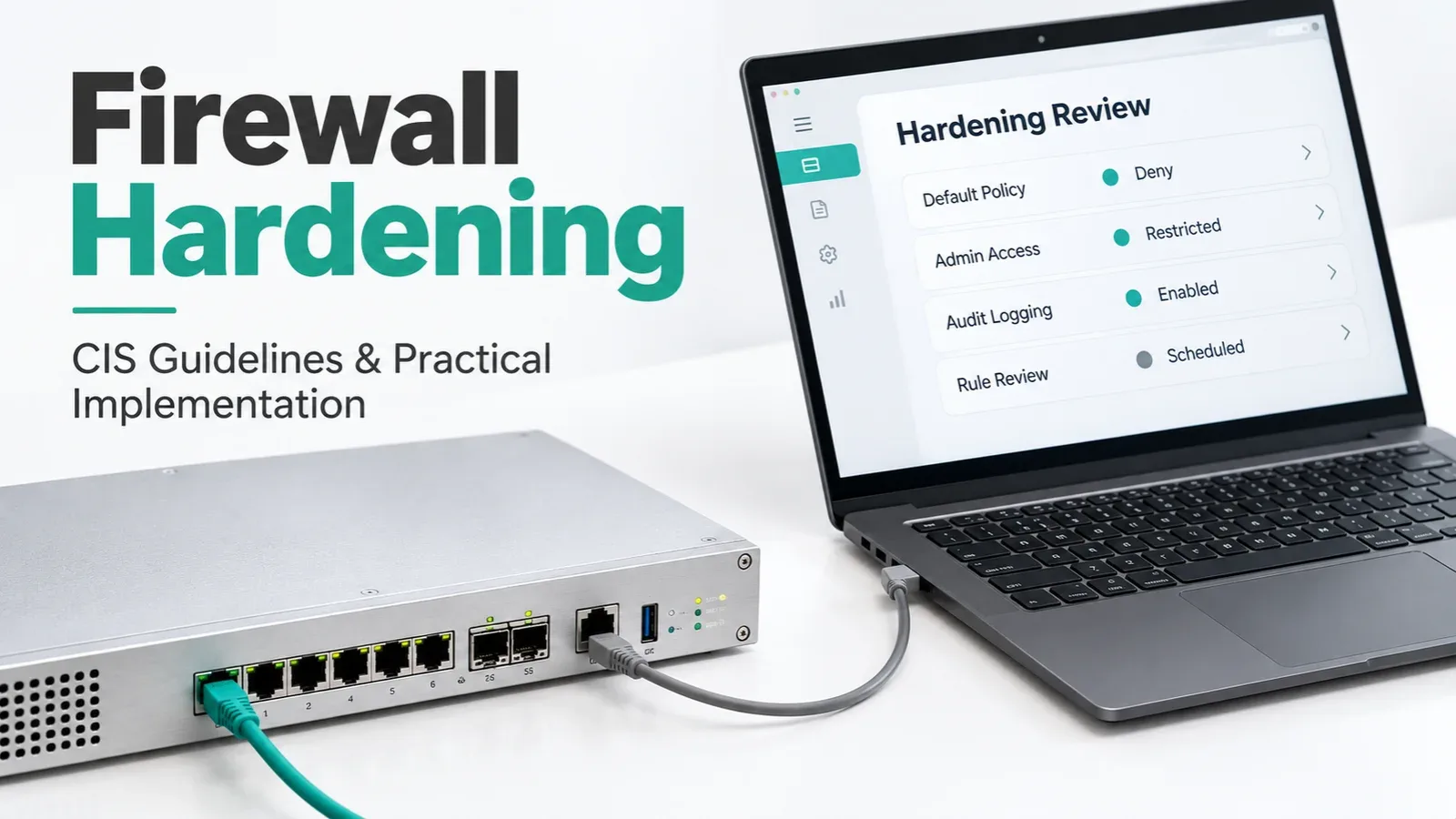
A firewall enforces traffic policy, but its own management interfaces, software and rules also need protection. Hardening reduces unnecessary exposure and misconfiguration risks across both external and internal network boundaries.
The Center for Internet Security publishes product-specific CIS Benchmarks and broader CIS Controls. Use the benchmark that matches the vendor, product and software version where one is available. General firewall rule-management advice is not a single universal CIS firewall benchmark.
What Does CIS-Aligned Firewall Hardening Mean?
Hardening combines an applicable configuration baseline with operational processes such as:
- Policy design and review
- Rulebase optimization
- Change control and documentation
- Logging and monitoring
- Regular audits and compliance checks
Record the benchmark title, version and assessment scope. Apply relevant recommendations, document justified exceptions and test their effect on required services.
Practical Controls for Firewall Hardening
1. Clear Policy Objectives
Define explicit security goals before implementing firewall rules. Policies should reflect business requirements and minimize open access unless justified.
2. Minimize Rule Complexity
Identify broad, redundant, shadowed or obsolete rules. Validate usage and application dependencies before removing or changing them, and retain a rollback route.
3. Logging & Monitoring
Define which security, traffic and administrative events must be recorded. Centralize relevant logs where appropriate, protect access and retention, and consider processing and storage capacity. Logging every packet or event indiscriminately is not a universal requirement.
4. Regular Audits
Conduct periodic reviews of rules, access patterns, and compliance with organizational policies. Automated tools help surface anomalies or risky configurations.
5. Change Control
Use formal processes for firewall changes, including approval workflows, versioning, testing, and documentation, to avoid errors and track changes.
6. Least Privilege Enforcement
Only allow necessary traffic. Apply the principle of least privilege and deny by default.
These activities support more controlled and auditable firewall operation. Add the platform-specific settings required by the applicable benchmark and the organization’s risk assessment.
Why Firewall Hardening Still Matters
In modern networks, threats are constantly changing:
Zero-Day Attacks
Attackers exploit unknown vulnerabilities that signature-based detection may miss.
Insider Threats
Misconfigured rulebases or excessive access privileges can allow internal users or compromised accounts to move laterally within the network.
Configuration Drift
Over time, rulebases can become inefficient, redundant, and difficult to manage, increasing the chance of security gaps.
Hardening improves the consistency and reviewability of access controls. It does not guarantee protection against every exploit or configuration error.
Technologies That Support Firewall Hardening
1. Rulebase Analysis Tools
Automated tools can analyze firewall configurations and detect risky, redundant, or shadowed rules.
2. SIEM & Log Analytics
Centralized collection and correlation of firewall logs help identify patterns and anomalies that indicate misconfigurations or attacks.
3. Policy Management Platforms
Policy-management platforms such as Tufin, AlgoSec and FireMon can support rule analysis, change workflows and reporting on supported systems. Check vendor and version coverage before relying on a report.
4. Automated Compliance Reporting
Where supported, assessment tools can evaluate selected benchmark recommendations. Automated checks do not cover every operational requirement or prove complete organizational compliance. Review manual checks and exceptions separately.
5. Cloud-Native Firewall Hardening
Cloud controls need service-specific assessment. AWS security groups and Azure Firewall policies are different types of control, so apply the relevant cloud guidance and supported benchmark checks rather than treating them as identical firewall appliances.
Future Directions for Firewall Hardening
1. AI-Powered Hardened Policies
Analytics and policy recommendations can help identify excessive access and propose changes. Validate the required flows and retain approval and rollback controls before enforcement.
2. Automated Compliance Workflows
Automation can assist assessment, change tracking and rechecking. End-to-end automated compliance should not be assumed, especially where manual evidence or exceptions are required.
3. Behavioral Firewall Threat Models
Identity, threat and session context can inform policy on supported platforms. Dynamic changes still need defined boundaries and an understanding of service impact.
4. Unified Policy Management Across Hybrid Environments
Hybrid policy-management tools can help coordinate supported controls. Their coverage and the consistency of enforcement depend on connectors, platform features and the quality of the policy model.
5. Integration with Zero Trust & SASE
Firewall hardening supports wider Zero Trust and SASE designs. Neither architectural label removes the need to secure administrative access, maintain software and review rules.
Firewall hardening is an ongoing process of baseline assessment, controlled change, monitoring and review. Keep evidence of the configuration, applicable checks, exceptions and corrective actions.
Prioritize exposed administration, unsupported software and unnecessary access, then work through the applicable baseline. Verify the outcome through configuration review, logs and tested service behavior.
A Practical Implementation Sequence
Record the firewall model, supported software, enabled services and management paths. Select the relevant CIS Benchmark where available and retain a configuration backup and recovery method.
Assess administrative authentication, privileged accounts, management exposure and unnecessary services. Then review traffic policy, software maintenance and logging against the applicable baseline. Test changes in a maintenance window with a rollback plan, verify required application flows and retain evidence of checks and approved exceptions.
Practical Next Step
Start with the firewall inventory, configuration and highest-risk exposure, then plan a controlled review. Discuss firewall support requirements with Servicing24 Limited.
Sources and Further Reading
Common questions
Is there a universal CIS firewall-hardening checklist?
CIS publishes product-specific Benchmarks and broader Controls. Choose the applicable product and software version rather than treating general advice as one universal benchmark.
Does a CIS assessment report prove full compliance?
No. Check scope, benchmark version, automated coverage, manual recommendations and exceptions. A report does not establish complete organizational compliance.
Should every firewall event be logged without exception?
Define logging according to security, operational and evidence requirements. Consider critical events, useful traffic visibility, storage and performance rather than indiscriminate logging.
Can unused rules be deleted immediately?
Validate usage and application dependencies before removal. Use change control, testing and a rollback route because infrequently used rules may support important services.
How often should firewall hardening be reviewed?
Review it as part of the organization’s risk-based maintenance process and after significant software, policy, topology or access changes. Set a documented schedule appropriate to the environment.
Need help with this in your own setup?
Talk to a Servicing24 engineer. We’ll give you a plan and a clear price.