In enterprise IT environments, maintenance and support strategy is just as important as the infrastructure itself. Once servers, storage, and network devices are deployed, organizations must decide how they will be supported throughout their lifecycle. The two most common models are OEM Maintenance and TPM (Third Party Maintenance).
This blog provides a clear, in-depth comparison of OEM vs TPM, helping IT decision-makers choose the right model based on cost, risk, performance, and long-term strategy.
What Is OEM Maintenance?OEM (Original Equipment Manufacturer) Maintenance is support and maintenance provided directly by the hardware manufacturer. This typically includes:
- Warranty support (initial years)
- OEM Annual Maintenance Contract (AMC)
- Access to firmware and patches
- OEM-certified spare parts
- Vendor-standard SLAs
OEM maintenance is usually mandatory during the warranty period and is widely perceived as the “default” or “safe” choice.
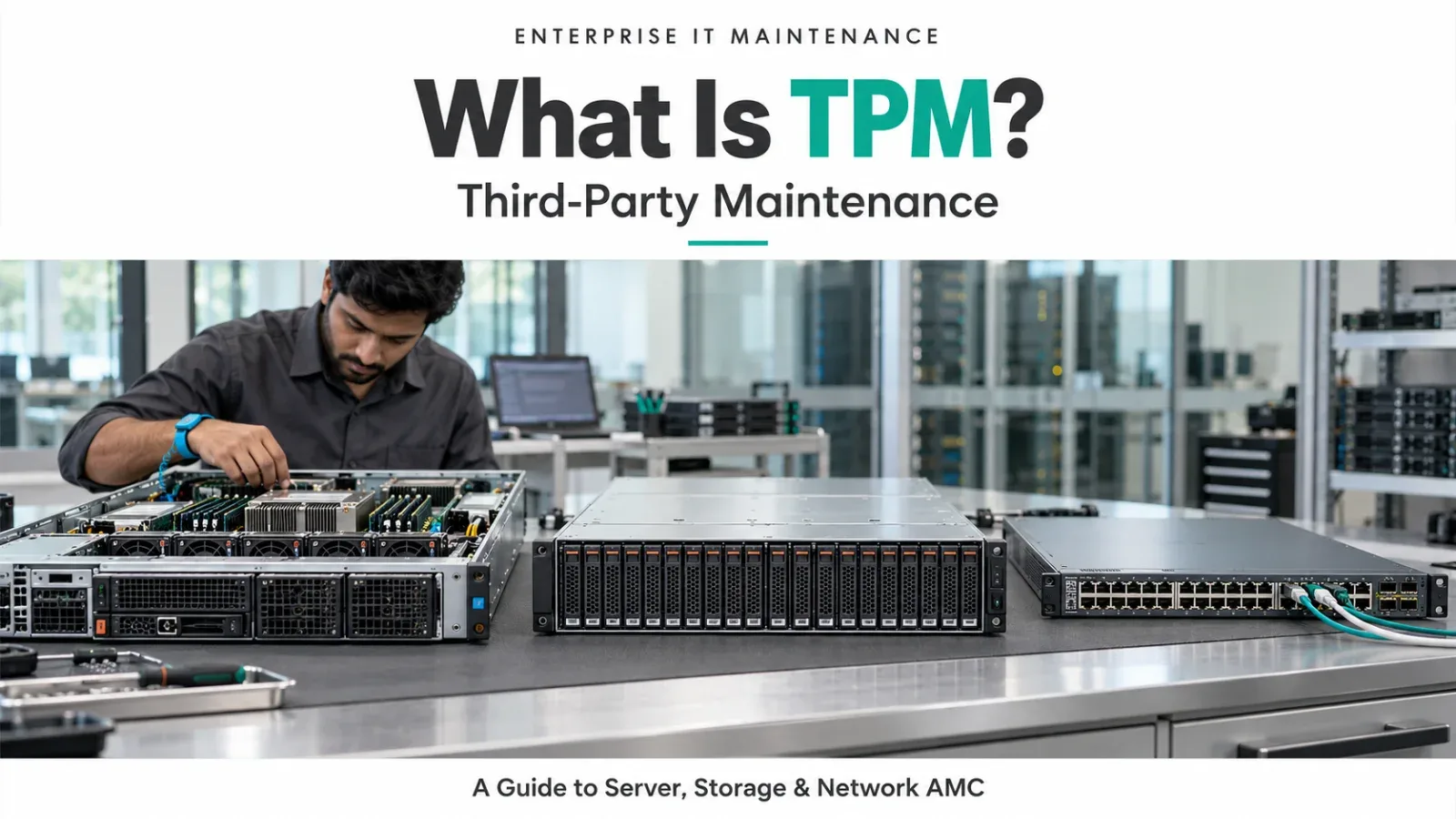
What Is TPM (Third Party Maintenance)?TPM (Third Party Maintenance) is post-warranty support provided by an independent service provider, not the hardware manufacturer. TPM covers:
- Servers
- Storage systems (SAN / NAS)
- Network devices (switches, routers, firewalls)
TPM focuses on keeping existing infrastructure running reliably, rather than pushing hardware upgrades or replacements.
Core Philosophy: OEM vs TPMThe fundamental difference lies in business intent.
- OEM Maintenance is product-driven
- TPM is service-driven
OEMs design support around their hardware sales lifecycle. TPM providers design support around uptime, cost control, and infrastructure longevity.
Cost Comparison: OEM vs TPMCost is often the first reason organizations evaluate TPM.
OEM Maintenance Cost Characteristics
- Costs increase every year
- AMC renewal becomes expensive after warranty
- Premium pricing for older hardware
- Limited flexibility in coverage scope
TPM Cost Characteristics
- 40–70% lower than OEM AMC
- Stable pricing year over year
- Pay only for what you need
- No forced upgrade pressures
For organizations running stable infrastructure, TPM delivers significant operational cost savings without sacrificing reliability.
SLA & Flexibility ComparisonOEM SLAs
- Fixed SLA tiers
- Limited customization
- Same response for all customers in the same tier
- Less flexibility for mixed-criticality systems
TPM SLAs
- Fully customizable SLA models
- Different SLAs for different systems
- Faster onsite response due to local spares
- Tailored escalation paths
TPM allows IT teams to align support cost with system criticality, which OEM models often do not.
Hardware Lifecycle ManagementOEM Approach
- Encourages hardware refresh
- Declares products End-of-Support (EOS)
- Limits support options for older systems
- Focuses on selling new platforms
TPM Approach
- Extends hardware lifespan
- Supports EOS and EOL equipment
- Maximizes return on investment (ROI)
- Keeps stable systems in production longer
TPM is ideal for environments where hardware performance is still sufficient and replacement is not yet justified.
Multi-Vendor Environment SupportModern data centers rarely run on a single vendor.
OEM Limitation
- Supports only its own brand
- Requires multiple AMC contracts
- Complex vendor coordination
TPM Advantage
- Single AMC for multi-vendor environments
- Unified support process
- Simplified escalation and reporting
- Vendor-neutral expertise
TPM significantly reduces operational complexity in heterogeneous environments.
Technical Support & ExpertiseOEM Support Model
- Remote-first approach
- Global support centers
- Script-driven troubleshooting
- Escalation often time-consuming
TPM Support Model
- Experienced field engineers
- Faster onsite access
- Practical, environment-aware troubleshooting
- Focused on resolution, not replacement
A mature TPM provider often delivers more hands-on and responsive support, especially in critical incidents.
Spare Parts & ReplacementOEM Spare Model
- Centralized inventory
- Long lead times for older parts
- High replacement cost
TPM Spare Model
- Local or regional spare stock
- Faster replacement
- OEM-grade or equivalent components
- Lower cost and faster recovery
This difference directly impacts Mean Time to Repair (MTTR).
Risk & Compliance ConsiderationsOEM Risks
- Vendor lock-in
- Escalating long-term cost
- Forced migration timelines
TPM Risks (When Poorly Chosen)
- Inexperienced providers
- Limited spare availability
- Weak SLA enforcement
Risk Mitigation with TPM
A professional TPM provider mitigates risks through:
- Certified engineers
- SLA-backed contracts
- Transparent service reporting
- Proven enterprise references
Choosing the right TPM partner is critical.
OEM vs TPM: Support Boundaries & Responsibility MatrixThis table clearly shows where OEM support usually stops and where TPM support continues.
| Area / Boundary | OEM Maintenance | Third Party Maintenance (TPM) |
| Warranty Dependency | Mandatory during warranty | Post-warranty focused |
| End-of-Life (EOL) Hardware | Not supported | Supported |
| End-of-Support (EOS) Models | Restricted or denied | Actively supported |
| Hardware Replacement | OEM-only, expensive | OEM-grade or equivalent |
| Multi-Vendor Coverage | Single vendor only | Multi-vendor under one AMC |
| SLA Flexibility | Fixed tiers | Fully customizable |
| Preventive Maintenance | Limited | Regular & proactive |
| Configuration Assistance | Minimal | Included (best-effort) |
| Firmware Lock-in | Strict | Stability-focused |
| Upgrade Pressure | High | None |
| Local Spare Availability | Centralized | Local / regional |
| Escalation Flexibility | Rigid | Direct & fast |
| Lifecycle Extension | Limited | Strong focus |
OEM is the right choice when:
- Systems are under warranty
- Cutting-edge features are required
- Regulatory compliance mandates OEM support
- Frequent firmware upgrades are critical
TPM is ideal when:
- Hardware is post-warranty
- Infrastructure is stable and mature
- Cost optimization is a priority
- Multi-vendor environments exist
- Business wants control over refresh cycles
The decision between OEM and TPM is not about right or wrong—it’s about fit.
- OEM Maintenance provides manufacturer-backed assurance but at a premium cost.
- Third Party Maintenance (TPM) delivers flexibility, cost efficiency, and extended hardware life without compromising uptime.
For many enterprises, the smartest strategy is a hybrid approach—OEM support for critical new systems and TPM for stable, post-warranty infrastructure.
In a world where IT budgets are under constant pressure, TPM is no longer just an alternative it is a strategic advantage.
Need help with this in your own setup?
Talk to a Servicing24 engineer. We’ll give you a plan and a clear price.